S22 E14 - Meet your AI Digital Twin
Twin Health's unique approach to improve health:

Host:
Cary Hall, America’s Healthcare Advocate
S22 E14 - Meet your AI Digital Twin
Twin Health's unique approach to improve health:
Metabolic Health Show - Twin Health's unique approach to improve health:
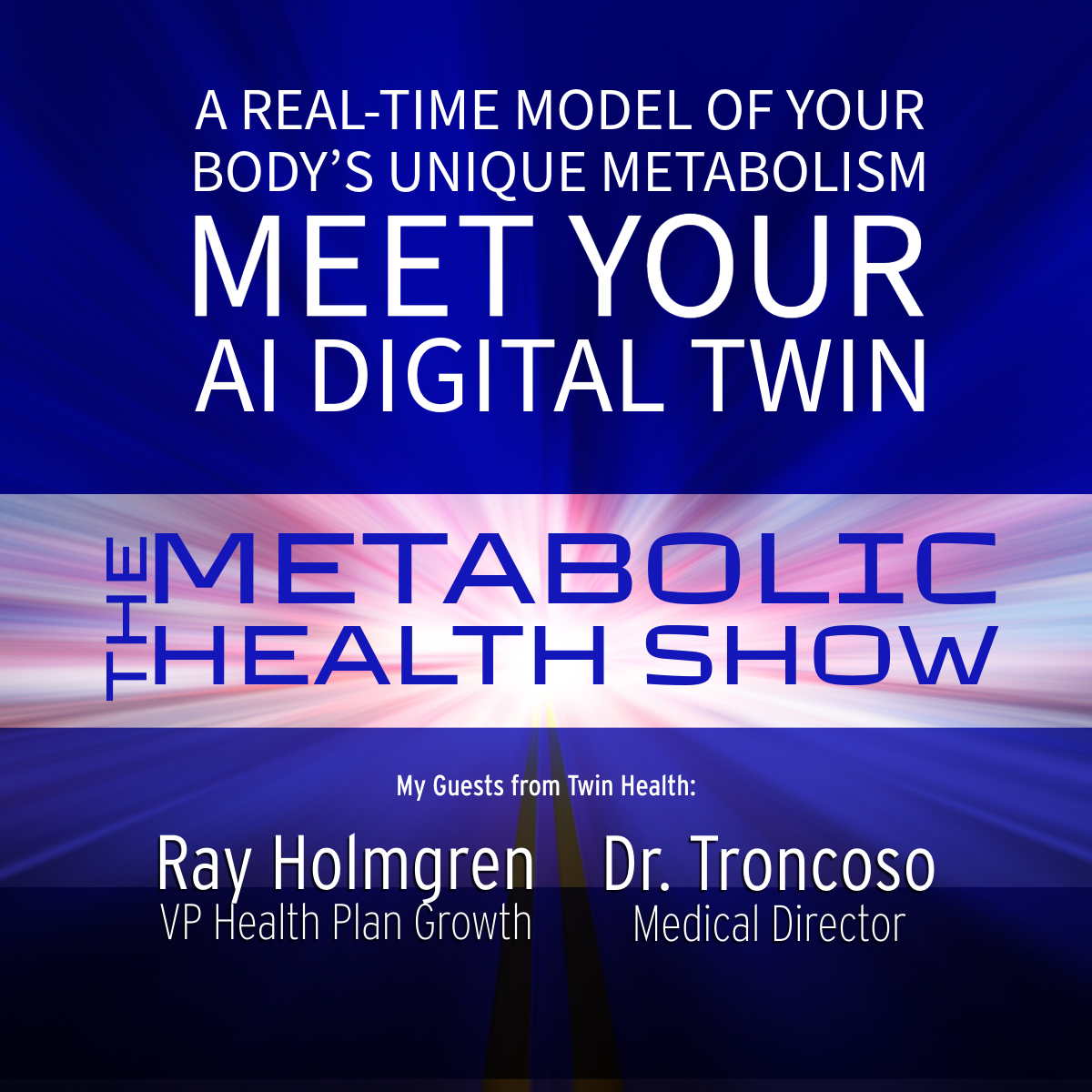
Meet your AI Digital Twin
Today my guests from Twin Health explain how they create a digital twin to actually help you in your health, especially if you're pre-diabetic, along with a number of other issues. We're going to tell you how it works, and what a difference it can make in your life.
It's a real-time model of your body's unique metabolism and Ray Holmgren, VP Health Plan Growth, and Doctor Troncoso, their Medical Director, visit with me on this fantastic new way to empower your employees with daily, personalized insights that adapt to heal their metabolism — improving weight, blood sugar, nutrition, activity, and more.
Don't miss this episode, which shows how Twin Health's "AI digital twin™" technology pairs with a human clinical care team to deliver hyper-individualized care at scale, an approach with a proven impact on the root causes of chronic metabolic disease.
Show Quote: In a landmark Cleveland Clinic trial, published in the New England Journal of Medicine Catalyst, our AI digital twin™ approach achieved results that redefine what’s possible in type 2 diabetes care.
This is season 22, Episode 14 of America's Healthcare Advocate. I'm Cary Hall.
After you watch or listen to the episode, learn more about Twin Health: https://usa.twinhealth.com
As always, if you need help or have something to share, contact me using the form on my website and let me know what's on your mind, the issues you are dealing with, or any other health, healthcare, or health insurance questions or concerns. Visit:
https://www.americashealthcareadvocate.com/contact-us
Listen to this episode
Below are audio podcast players to stream from here on our website. or search for "America's Healthcare Advocate" on your favorite podcast platform.
On Rumble:
Play full audio podcast (above) or find it by clicking from the list below:
iHeart
Episode 2214 Transcript
00;00;00;07 - 00;00;16;21
Cary Hall
Coming up on today's show, we're going to talk to Doctor Alex Troncoso from Twin Health. He's the medical director and Ray Holmgren he is the vice president at Twin Health. We're going to talk about how their program creates the digital twin of your metabolism.
00;00;16;24 - 00;00;20;23
Announcer
And now America's Healthcare Advocate, Cary Hall.
00;00;21;01 - 00;00;23;15
Cary Hall
Hello, America. Welcome to America's Healthcare Advocate.
00;00;23;15 - 00;00;44;25
Cary Hall
Show broadcasting coast to coast across USA here on the HIA Radio Network. You can find out more about us by going to the website AmericasHealthcareAdvocate.com 16 podcast platforms and the YouTube platform. We're on all of them. You can download these shows and listen to them. We've got a lot of people to do that. About 653,000 actually last count.
00;00;44;25 - 00;01;04;09
Cary Hall
So there are a lot of you we really appreciate what you do. And of course, to all of you out there listening to us on the radio at our 243 affiliates across the country, we greatly appreciate all of you. So today's show is going to be a little interesting. You know, I sometimes say that we separate fact from fiction and we also talk about the latest technologies and advances in medical.
00;01;04;11 - 00;01;26;12
Cary Hall
Well, what if I told you that you could create a digital twin that would help you improve your health and make a dramatic difference in your lifestyle and how you live? Sounds like fiction. Well, it's not, and I'm going to tell you why. In studio with me today, doctor Alex Tronoso, from Twin Health and vice president of Twin Health, Ray Holmgren.
00;01;26;13 - 00;01;45;24
Cary Hall
And we're going to talk about their program, Twin Health, and how they create a digital twin to actually help you in your health, especially if you're pre-diabetic, diabetic, any of those things, along with a number of other issues. We're going to tell you how you can do that, how it works, and what a difference it can make in your life.
00;01;45;24 - 00;02;06;17
Cary Hall
And you know what? I think it's so good that I've enrolled in the program. So, Ray, let's just start, okay? And talk about, what is Twin Health? You know, how how does it work? A little bit about it, how it was established, especially. Let's talk a little about your founder and his history and then how this all came about.
00;02;06;17 - 00;02;07;07
Cary Hall
Ray.
00;02;07;09 - 00;02;39;17
Ray Holmgren
Yeah. So our our CEO and co-founder, Jahangir Mohammad is a serial entrepreneur. Twin is actually his third company. He has spent his career in and digital technology. He's kind of credited for creating ‘the information of things’ platform. So he's spent his, his, his career on developing and leveraging sensor technology to better understand complex systems. And he set out after he sold his second company.
00;02;39;18 - 00;02;58;00
Ray Holmgren
He really wanted to help people and prove their health. And so he kind of said to himself, if you know, if I can build, you know, a digital twin of these really complex systems, like, why can't I build a digital twin of the human metabolism to help people live happier and healthier lives? So that's what he set out to do.
00;02;58;02 - 00;03;23;06
Ray Holmgren
So in a nutshell, we've spent the last eight years developing our proprietary technology called the Whole Body Digital Twin. Essentially what that is, is. So I'll just explain digital twin technology. So it's been around for decades. So engineers who are trying to better understand a physically complex system. So think a self-driving car, a nuclear power plant, a jet engine or even an airplane itself.
00;03;23;09 - 00;03;50;08
Ray Holmgren
Engineers are using digital twin technology with a variety of different sensors gathering thousands of endpoints, inputs of data, and using AI and machine learning to better understand the complexities of that system. To identify whenever there's an issue with that system and create improvements in near real time. So we're taking that same concept and applying it to the human metabolism.
00;03;50;11 - 00;04;15;08
Ray Holmgren
So when a participant enrolls in our program, we start off with doing a baseline lab assessment. We look at 50 different metabolic parameters. It's a very comprehensive lab work. So our understanding at the biological level, like what is happening within the human with each participant's metabolism. We then provide them a kit of sensors. So each participant receives a continuous glucose monitor.
00;04;15;11 - 00;04;34;20
Ray Holmgren
So this is a patch that you wear on the back of your arm or your abdomen. It collects blood sugar readings every five minutes. So you know that our type two diabetic participants get really excited because they no longer have to worry about finger pricking, which is, a huge relief for them. We also provide a fitness tracker.
00;04;34;21 - 00;04;56;23
Ray Holmgren
We have a partnership with Garmin. So it's the fitness tracker is really important because we're not just looking at, a person's steps, but we're looking at their sleep data. We're looking at their heart rate, their heart rate variability. We're calculating their stress levels throughout the day. We give them a blood pressure cuff as well as a body scale and the body scale doesn't just look at weight.
00;04;56;25 - 00;04;59;29
Ray Holmgren
It's looking at their visceral adiposity.
00;04;59;29 - 00;05;03;12
Cary Hall
So the the okay hold of it. We got to go back to say that one more time.
00;05;03;13 - 00;05;04;26
Ray Holmgren
Visceral adiposity.
00;05;04;27 - 00;05;06;17
Cary Hall
I can't wait to hear what this is. Yeah.
00;05;06;17 - 00;05;37;09
Ray Holmgren
So it is basically the fat that stores around your organs. But we're looking also at lean muscle mass. We're looking at bone density. We're looking at your water weight. And so we're gathering over 3000 data points for each participant every single day. And then we have our proprietary patented technology where we are able to predict and understand what are the interventions that that person needs to heal their body.
00;05;37;09 - 00;05;48;00
Cary Hall
So it's tailored to each person's needs. This is not a size 44 overcoat. Here, put this on. We're going to take care. This is this is for because everybody's different. And that's what you're saying here.
00;05;48;01 - 00;06;10;14
Ray Holmgren
Everybody's metabolism is unique. And that is and that's part of the challenge that we've seen in health care is, you know, we've spent decades throwing a number of different solutions, digital health solutions where, you know, fitness trackers, all these things. But none of it's been, you know, has, as the physician can attest, it's been generic advice, like, you go to your doctor and you hear.
00;06;10;14 - 00;06;25;16
Cary Hall
Exercise more. Lose weight. Don't eat a lot of sugar. I can tell you what the are because I said I'm a participant in this program now, right? Okay, I hear the same. I'm on the air. I gotta watch how I phrase this. I hear the same things when I go out or here, here's the silver bullet.
00;06;25;16 - 00;06;41;23
Cary Hall
We're going to give you Wegovy we're going to give you one of the weight loss drugs. And my problem with that was and I told you this last night at dinner, doctor, I'm like, yeah, that really sounds good in the short term. And then what happens when you stop taking it? Or do you start this yoyo thing?
00;06;42;00 - 00;06;59;06
Cary Hall
And then there are no studies that are ten year studies that say, what are the effects of this medication ten years from now? And what do you do at the end of the year when you've run the course, you stay on the stuff for a lifetime. You stick a needle in yourself for, I don't know, okay. But I walked away from it.
00;06;59;06 - 00;07;03;08
Cary Hall
I'm like, I'm not doing this. So, your thoughts.
00;07;03;11 - 00;07;28;09
Dr. Alex Tocoso
Right? So obviously GLP's are a hot topic these days. To say the least. Among employers, among health plans. And, you know, one thing I'll say is that we think that GLP's are actually a good tool. Okay? We think they can be a good tool to help, improve A1C and lower BMI, but we don't think that the GLPs are for all patients for the rest of their lives.
00;07;28;09 - 00;07;28;29
Dr. Alex Tocoso
Right. Okay.
00;07;29;07 - 00;07;37;18
Cary Hall
And that's not how they're being advertised. They're being advertised as the silver bullet. Every damn ad you see on television, on radio, it's the same thing.
00;07;37;20 - 00;07;57;09
Dr. Alex Tocoso
Correct. I would say many providers, you know, primary care nurse practitioners, you know, the prevailing guidance has been we'll start you on the medication, but they don't really talk about what happens eventually. Do you ever come off the medication? So there's really no, kind of discussion towards that. That end point, if there is one.
00;07;57;12 - 00;08;29;14
Dr. Alex Tocoso
And, you know, the studies have shown, that over time the efficacy of these medications does go down. Yep. Okay. And also after about a year, many people have stopped taking the medication anyway because of various reasons. Side effects cost a number of other a number of other things. So, you know, I twin we help to give these patients an off ramp so we can, we can sustain the weight they've lost on the GLP and even get them additional weight loss while deprescribing the medication on the twin program.
00;08;29;21 - 00;08;47;04
Cary Hall
So you can actually you're not against it, but you're managing in such a way that it is a solution. As you move to a life changing event where people start to live their lives differently. Correct. I mean, I look at some of the, some of the things that I read that people are saying, you changed my life.
00;08;47;10 - 00;09;07;06
Cary Hall
You gave me more years. You saved my life. That's pretty strong. Yeah. I mean, yeah, I'm 76 years old, soon to be 77 next month. Okay. And I've got six grandchildren. I intend to be around for a long time. Yeah. Okay. So to me, when I see that kind of thing, I'm like, this really can make a huge difference for people.
00;09;07;06 - 00;09;22;28
Cary Hall
And I think it will make a huge difference for people. The problem is getting the message out there and getting employers and brokers and people to understand this. So we're going to come back from the break. We're going to talk about why is metabolic disease such a big deal? Why is it so hard to manage? Why do we keep struggling with it?
00;09;22;28 - 00;09;41;27
Cary Hall
Well, the doctor is going to talk about that okay. So we'll be right back after the break. You're listening to America's Healthcare Advocate broadcasting coast to coast across the USA. If you want to learn more about this, they've got a fabulous website. It's called TwinHealth.com. I was up on it again this morning, but I did all the show notes last week.
00;09;41;27 - 00;09;55;17
Cary Hall
I was on it. They've got a it's a remarkable site. There is a place in there for brokers if you want to reach out to them, employers if you want to reach out to them. There's a way you can do all of that and you can learn more about this. Once again, the website is TwinHealth.com. Stay tuned.
00;09;55;17 - 00;10;10;08
Cary Hall
We'll be right back after the break. The Doctor is in the house stay with us.
00;10;10;11 - 00;10;29;15
Cary Hall
Welcome back. You're listening to America's Healthcare Advocate Show broadcasting coast to coast across the USA on the HIA Radio Network. Want to say hello to our affiliate in Anchorage, Alaska, KBYR, Anchorage, Alaska AM-700 a been on the air for quite a while up there. Been to Anchorage. I love that part of the country. It's great up there.
00;10;29;17 - 00;10;52;07
Cary Hall
Glad to have you as part of our family. Doctor, let's talk about why metabolic diseases are so critical. And the other piece of that thing is, along with diabetes, all the rest of it is the number of people in this country that are obese and morbidly obese. We're looking at numbers close to 70% that all kind of paint the picture, how all this kind of comes together, doctor.
00;10;52;07 - 00;10;52;21
Cary Hall
00;10;52;24 - 00;11;22;26
Dr. Alex Tocoso
Thanks, Cary. And you are right. You know, the, prevalence of obesity has gone up significantly over the past several years. And that in itself, is a predisposition, to the whole spectrum of, metabolic cardiometabolic disease. And I think one of the mistakes that, people tend to make is to try and separate these diseases out into specific conditions, per se, when in reality, this is all kind of under the umbrella of cardiometabolic disease.
00;11;22;26 - 00;11;46;14
Dr. Alex Tocoso
And it's really a spectrum, of something that starts, you know, in our younger years and really, kind of progresses consistently throughout our lives, until we start to show symptoms. And this is kind of where traditional medicine, in my opinion, has started to fail us because the model of medicine right now is a more reactive model.
00;11;46;16 - 00;12;10;14
Dr. Alex Tocoso
It treats a symptom or a condition once it is presented itself. Correct. Which in certain ways makes sense. But at the same time, by that time, the damage a lot of the time has already been done. Okay. So what we try and do as opposed to, you know, going to see your primary care doctor 3 or 4 times a year, having them adjust a medication, add a medication, see you in three months.
00;12;10;16 - 00;12;35;12
Dr. Alex Tocoso
We try to do more of a, continuous care model where we, you know, join with the patient earlier on, you know, in their in their, course, and really identify what's going on with their metabolism, using our sensors, and we combine the data that we get from our sensors with a live care team that includes physicians, nurse practitioners, nurses and health coaches.
00;12;35;14 - 00;12;45;11
Dr. Alex Tocoso
And we really try and treat the whole person again on a more consistent basis. So that we can help to improve their overall metabolic health.
00;12;45;12 - 00;13;14;28
Cary Hall
So what you really trying to do is, is on a day to day basis, get them to change their lifestyle correct. And and so this was amazing at dinner last night. So we're at dinner last night and I'm talking about the phone app because the phone app is really cool right. And when I first talked to Ray and we talked about this is I said, well, you know, the problem with all these programs, the program I was in over at the weight loss clinic I was in where I lost 20 pounds, got myself where I am and I've held.
00;13;15;01 - 00;13;29;10
Cary Hall
But the point is, you have to if you're really going to manage it, you have to go through. And how what do you eat? How many calories? Here's the list. Well, Ray says, you don't have to do that well. Oh well what do you do. Oh you just take a picture of the food. So last night at dinner.
00;13;29;12 - 00;13;57;05
Cary Hall
He takes a picture of Grilled Octopus. Said, this is never going to be on there. And lo and behold, it came up right, Ray. It came up. It showed the Grilled Octopus how many calories, what it was going to do. And the same thing with he had Osa Buco and it did exactly the same thing. The part that was fascinating to me is that information in your system now is going to tell you your A1 C's going up here, why you eat this stuff, you can eat it.
00;13;57;07 - 00;14;16;29
Cary Hall
But here's what you need to do to offset. So a little bit, because that that's this whole thing with day to day is it's real time right now. Right. And it's not a pain in the neck. Do you're making it simple enough that people in my age the number two pencil in a dot com world, right okay. Are able to do this kind of stuff.
00;14;16;29 - 00;14;18;07
Cary Hall
So talk a little bit about that.
00;14;18;13 - 00;14;49;15
Dr. Alex Tocoso
Sure. So that kind of goes more towards the personalization aspect of the program. Which we think is kind of one of the cornerstones, of the twin program. But basically everyone's metabolism is different. And everything that you do from a dietary medication activity, sleep stress standpoint affects each person differently. So, you know, for example, with the foods there as we build their digital twin and get more data points on each patient, we can build a much more every day.
00;14;49;15 - 00;14;55;04
Dr. Alex Tocoso
It gets more and more accurate. For example, if something the octopus that, Ray had last night. Yeah.
00;14;55;04 - 00;14;57;12
Cary Hall
Which I didn't eat, by the way. Thank you.
00;14;57;15 - 00;14;58;00
Dr. Alex Tocoso
It was very.
00;14;58;00 - 00;15;02;02
Cary Hall
Good. I'm sure it probably was. I know it's a little stretch.
00;15;02;04 - 00;15;24;03
Dr. Alex Tocoso
So the octopus that Ray took a picture of yesterday that went into his algorithm through his app, and the app told him, okay, you're having grilled octopus with chickpeas and, an aioli sauce. If you eat this, your glucose will go up by this amount. Okay. But. And we're not we're not going to tell you that you can't eat something.
00;15;24;10 - 00;15;32;23
Dr. Alex Tocoso
We'll tell you. You can eat what you want to eat, but we'll give you options or ways to help mitigate the damage from that particular meal.
00;15;32;25 - 00;15;51;29
Cary Hall
Right. But so so you're, you're you're managing it in real time. This is not okay. I got to go to fill out the chart. Then I got look at the chart. Then they go back to what was my day's activity. This is all being fed into this system, this Twin digital system that you've created for for me, specific to me in my needs.
00;15;52;01 - 00;16;13;10
Cary Hall
Okay. You ate that in my case. In my case, let's say it's a Friday and it's I've had just a slice of coconut cake. And it's going to say, now that you ate your coconut cake, you need to go walk around the block for ten minutes or do something to offset what you do. Doesn't mean you can't do it, but there's a way to compensate for it, so you're disciplining yourself to do it.
00;16;13;13 - 00;16;35;17
Cary Hall
It's okay to do it, but there's a here's what you need to do to offset that that's going to affect your A1C. So you're really enabling people in real time to manage this, which is something it's never been done before. I mean, I'm it's I look, I've been battling pre-diabetes for I don't know how many years and I've never allowed myself to get to type two diabetic because it scares the hell out of me.
00;16;35;17 - 00;16;45;27
Cary Hall
But having said that, I never saw a tool like this. I mean, real time data that's going to tell me, hey, guess what? You can eat that, but you better do this or this or this.
00;16;45;29 - 00;17;07;12
Dr. Alex Tocoso
And that's too important points that you bring up. You know, I think that when a program or a diet is restrictive, it makes it very hard for the person to follow. Okay. So that's the first thing. And, you know, and the second thing, you know, we just we try to let them eat whatever they want, but give them those options, you know, in terms.
00;17;07;12 - 00;17;29;26
Cary Hall
But it's also it's self-correcting to a certain degree, real time. I mean, you're going to do this and you're going to go, hey, do I really need do I really want that second slice of cake? Correct. Probably not a good idea. I mean, it’s helping you what I see here and yet and I've been a health insurance broker for 27 years, and I asked this question last night you hit it right on the head.
00;17;29;26 - 00;17;47;08
Cary Hall
I said, how many what's the percentage of people you think participate in a wellness program? And we've done hundreds of them over the years with our with our employer clients and that we were working with and and you hit it and you said 10%. I said, yeah, 10% is what it looks like. We're lucky if we get really get seven.
00;17;47;11 - 00;18;03;08
Cary Hall
So you can put as many programs out there as you want. But if people don't use it doesn't mean a damn thing. The beauty of this, of Twin Health is it's right there in your face. And if you really want to, do you know, you really want to be healthier, you really want to live longer. You really want to have a different lifestyle.
00;18;03;10 - 00;18;17;19
Cary Hall
We're going to help you make that happen, is what you're saying. And it's actually quite remarkable the way that it works and it all comes together. So, we're going to come back after the break. When we come back from the break, we're going to, you know, if you think you're listening is thinking, yeah, this is a lot of hoodoo voodoo.
00;18;17;19 - 00;18;50;16
Cary Hall
Well, we're going to come back and tell you about a study, a Cleveland clinic, right? It actually verifies everything we're talking about here today. And if you're a broker or an employer, you're talking about cost containment and claims issues. You better listen to this next segment. We'll be right back after the break. You're listening to America's Healthcare Advocate broadcasting coast to coast across USA.
00;18;50;18 - 00;19;18;06
Cary Hall
Welcome back. You're listening to America's Healthcare Advocate Show broadcasting coast to coast across USA here on the HIA Radio Network. In studio with me, Ray Holmgren, vice president, Twin Health and doctor Alex Trocoso. He is the medical director at Twin Health. We're talking about the metabolic twin, the program that they make. It fits you, fits your needs and helps you change your path in terms of life expectancy, enjoyment of life and what they can do to get.
00;19;18;08 - 00;19;37;22
Cary Hall
If you're pre-diabetic, diabetic. This is a program that can change things and make a big difference. Now we're going to talk about a study that was done that I think is really important here. We're going to talk about a study that was done by Cleveland Clinic. And I think that really kind of defines, and the credibility that it gives to Twin Health is actually remarkable.
00;19;37;22 - 00;19;49;26
Cary Hall
So, Ray, let's talk about this because when I saw this, I saw these numbers, I was like, you know what? If you're an employer or you're a broker and you want to know if this really works, this this is the icing on the cake. That proves it does work.
00;19;49;26 - 00;20;11;11
Ray Holmgren
Right? When we set out, like, you know, anyone can go to our website and see our commercial outcomes, but it was really important to our founder and our chief medical officer to be able to validate with a world class clinical institution like Cleveland Clinic that we're putting our money where our mouth is and we can actually deliver on these outcomes.
00;20;11;13 - 00;20;37;05
Ray Holmgren
So we partnered with the Cleveland Clinic. We published a study in the New England Journal of Medicine Catalyst, which anyone is welcome to check out. The trial was completely conducted by the Cleveland Clinic with our endocrinology team led by Doctor Kevin Pantaloon. They did the randomization, so they use their own patients that were seeing a, Cleveland Clinic physician out of Twinsburg, Ohio, which no pun intended.
00;20;37;07 - 00;20;38;05
Ray Holmgren
But they selected.
00;20;38;05 - 00;20;38;08
Cary Hall
00;20;38;08 - 00;20;39;25
Cary Hall
You picked that on purpose.
00;20;39;27 - 00;21;14;03
Ray Holmgren
That was that was all them. So they they ran the trial, they did the study design. They did the randomization of their own patients. They randomized 150 patients, 100 participants into the twin cohort and 50 participants just continued to receive usual care, throughout it was a 12 month study, and the primary outcome was to see, to determine twins ability to, you know, reverse type two diabetes among the type two diabetes participants, which the Cleveland Clinic defined as having an A1C less than 6.5.
00;21;14;04 - 00;21;15;12
Cary Hall
That's the one.
00;21;15;15 - 00;21;41;20
Ray Holmgren
And while simultaneously eliminating all medications and antidiabetic medications with the exclusion of metformin. So we looked at, diabetes reversal. We looked at weight loss or looked at medication elimination. I'll start with the usual care group. So in the usual care group, only 6% of the participants reverse their type two diabetes. They had 14 pounds of weight loss at the 12 month mark.
00;21;41;22 - 00;22;19;03
Ray Holmgren
And medication usage actually increased by 6%. In the Twin group, we 71% of participants normalized their A1C, while simultaneously eliminating all antidiabetic medications with the exception of metformin. We saw twice the amount of weight loss as the control group at about 24 pounds. And then, we also eliminated over 80% of antidiabetic medications. What's really interesting, too, is that when you look at GLP1 medications alone, we eliminated 85% of GLP1s, which is really important.
00;22;19;05 - 00;22;27;29
Ray Holmgren
So not only did we achieve double the amount of weight loss as the control group, but we did so while simultaneously eliminating GLP1s.
00;22;28;01 - 00;22;50;02
Cary Hall
Doctor, when you look at this and the effect of this okay, weight loss. GLP1s are weight loss drugs for all you people that know what that is. But you should. But anyway, that's what they are. But when you look at this overall and one of the biggest problems with diabetes too, then this goes right back to brokers claims that employers and human resource directors is the comorbidities.
00;22;50;04 - 00;23;09;23
Cary Hall
So when you're doing this, not only are you, you know, moving them back from type two diabetes to not type two diabetes to regular normal, no issues. Okay. But what about all the comorbidities that are going away? Because this is one when we talked about this dinner last night and it's like, well, you know, employer we need to measure this.
00;23;09;23 - 00;23;34;08
Cary Hall
And employers there's this and that. And so wait a minute. What about, you know, the issues that come along with diabetes that are comorbidities. They have the highest number of you go to any plan. You know, at Detego, we've got, I don't know, 200,000 people on various plans that are, you know, our TPA runs. You go through the list that the top claims number across the board centers on diabetic period.
00;23;34;15 - 00;23;44;19
Cary Hall
So talk about the comorbidity issue and how this does a lot more than it just causes you to lose weight okay. And get you off the weight loss drugs talk about that.
00;23;44;19 - 00;24;07;19
Dr. Alex Tocoso
So, you know, part of the study, well, that the main focus of the study was to treat diabetic and pre-diabetic. Correct. But, you know, in within that we also wanted to make sure, that we were not causing any, you know, harm to any other systems in the body. Right? So not only do we not cause any harm to any other systems in the body, but we really improved numerous other biomarkers across the board.
00;24;07;24 - 00;24;40;17
Dr. Alex Tocoso
You know, during this past, during that year, of the study. So for example, hypertension was normalized in two thirds of the study participants, cholesterol was normalized in over 70% of participants and fatty liver disease was improved in over 85% of the patients. And that was actually verified directly through MRI. And not to mention improvement in, kidney function as well as a decrease in the Framingham risk score, which is the likelihood of a cardiac event in the next ten years.
00;24;40;20 - 00;24;59;11
Dr. Alex Tocoso
So it really has shown not only that we're improving, the type two diabetes and helping with the weight loss, but also helping a lot of these other adjacent, conditions, again, which people were thinking are, you know, separate conditions, but really are kind of part of the same metabolic umbrella.
00;24;59;11 - 00;25;19;07
Cary Hall
When you dial that in and you look to me, when I look at that, I'm an employer or I'm a broker or I'm a human resource director, and I've got, you know, 27% increases every year, 30% increases. I've seen numbers as high as 37 or 40% in some of these level premium plans that are out there, which depend on your claims numbers.
00;25;19;14 - 00;25;39;00
Cary Hall
Yeah, it looks really good for the first two years that it blows up the third year and you get 100% increase. Yeah, you can renew. But look, you know, so what do people do. They move off and they jump over on to the various plans that are set up by the government through the regulatory process that are not those in other words, you know, the Obama care plans, if you will, or the ACA plan.
00;25;39;00 - 00;25;54;27
Cary Hall
So this is impactful. And I think that's a message it really needs to get across, because you're not just dealing with the type two diabetes. You just listen to what you know what, doctor? Just said? Fatty liver, blood pressure, cholesterol. Hello.
00;25;54;29 - 00;25;55;11
Ray Holmgren
Right.
00;25;55;11 - 00;26;14;04
Cary Hall
Okay. I mean, I'm going to be thrilled if I can get off blood pressure medicine at around since I was 23 years old. Yeah, I'm probably pretty happy about that. Okay, same thing on the cholesterol side. If I can get off the cholesterol med, I'm going to be thrilled. So I'm the employer. I got 300 employees in the top and I got 30 people in this company.
00;26;14;04 - 00;26;33;05
Cary Hall
They're driving claims through the roof, and of those, 20 are diabetic, right? Duh. Yeah. Think it might make a difference. Yeah. So to me, when I look at this, it's the effect of the overall program. And, and how that works and how that translates back. Is that a reasonable interpretation?
00;26;33;07 - 00;27;07;03
Ray Holmgren
Yeah. I mean, that's that's what we hear from our members. It's what we hear from our employer partners, it’s what we hear from our payer partners as well. Everyone has again spent several years dealing with point solutions where it's either generic advice or they're really focused on helping participants live with their condition and manage the disease. And a lot more employers and brokers and payers are looking for solutions that can actually improve someone's health outcomes and actually make a difference in and, you know, improve weight loss.
00;27;07;05 - 00;27;10;18
Ray Holmgren
Lower A1C, and most importantly, eliminate those high cost medications.
00;27;10;18 - 00;27;32;06
Cary Hall
Well, you said it in the previous segment. We're treating the symptoms. That's the way a typical medicine works. I have a lovely, fabulous primary care physician. First thing she said was well, let's get you on Welgovy. I'm like, no, I don't think so. I think I’m going to pass on that one. Okay. But that's the mindset that's not that's not a solution.
00;27;32;07 - 00;27;33;13
Cary Hall
Right. That's a bandaid.
00;27;33;13 - 00;27;58;26
Dr. Alex Tocoso
That's the way the health care system is built today. Right. Because they they can't they don't have the infrastructure to monitor and manage these patients as closely as we do. Okay. Your primary care doctor could never monitor your CGM, your glucose monitor numbers, you know, 24 hours a day, seven days a week and make adjustments to the medications every few days based on you know what your glucose numbers are showing.
00;27;59;02 - 00;28;05;15
Dr. Alex Tocoso
But we can do that. So you're not seeing the doctor four times a year. You're seeing them four times a month sometimes.
00;28;05;17 - 00;28;26;11
Cary Hall
Yeah. So if you know, if things are starting to work, instead of taking metformin in the morning and metformin at night, maybe you're only taking it in the morning. Okay. And then maybe you get to it or you're not taking it at all. But you have created a behavioral change. The thing that I think that needs to really get across to the audience here is this is not a, you know, a one and done type of solution, like the weight loss drugs.
00;28;26;11 - 00;28;34;21
Cary Hall
And some of the other things are this is a behavioral change that's going to change the way you live your life. Am I correct in that assumption?
00;28;34;23 - 00;28;59;05
Dr. Alex Tocoso
Absolutely. And it's something that we want to give the members that is sustainable, right. Because, you know, after you can only be on, you know, for example, a keto diet for so long before you relapse, you can only be on the GLP for so long before it stops working, you know, it's really a matter of changing the behavior of the individual and having them see how certain, external forces affect their own body.
00;28;59;11 - 00;29;02;20
Dr. Alex Tocoso
And once they see it, they're the ones that have to make the change.
00;29;02;20 - 00;29;27;17
Cary Hall
That changes everything. Yeah. Because you're putting it right back in their lap and they're able to see significant results, which then translates out to a healthier group of employees. And translates out to lower claims across the board. Across the board. You're interested in this. You're listening. This. You think you know that? Maybe I'll take a look. This if you're a broker and you really want to introduce something, and we're going to talk about how this gets set up, you're going to be surprised to hear there's no out-of-pocket cost on this to get it in the door.
00;29;27;22 - 00;29;46;06
Cary Hall
We're going to tell you that in the next segment, going to go to the website TwinHealth.com. It's a great website. There's a ton of information up there. I urge you to take the time to look at it and then reach out to these folks and see how they can help you and what they can do to make your book of business better.
00;29;46;06 - 00;30;10;16
Cary Hall
And if you're the employer, the HR director, and you're concerned about where your costs are going, this is a great way to get them back under control. We'll be right back after the break. You're listening to America's Healthcare Advocate Broadcasting here on the HIA Radio Network. Coast to coast across USA. Doctors still in the house don't go anywhere.
00;30;10;19 - 00;30;25;22
Cary Hall
Welcome back. You're listening to America's Healthcare Advocate show, broadcasting coast to coast across USA here on the HIA Radio Network. You know, you're listening to this. Maybe you're the HR director and you want to go to the boss and say, hey, this is something we need to take a look at. This might make a big difference for us.
00;30;25;22 - 00;30;40;20
Cary Hall
Or maybe you're a broker and you've got a client, or this thing is going through the roof. You want to go tell somebody about this. You can go to the podcast, you can go to the YouTube. It's all right there. Send them a link so they can watch or listen to it and they'll understand what you're talking about.
00;30;40;20 - 00;30;57;15
Cary Hall
You don't have to go through and redo everything we're saying here. You can do that. And it would make a lot of sense. So that's one reason why we have 653,000 downloads is because people are doing this that I'm urging you, you know, if you're that H.R. Director, if you're the employer, if you're the broker, this is a tool you want to take a look at.
00;30;57;15 - 00;31;07;20
Cary Hall
So let's talk about this Ray. You know, what does it cost okay. How do I implemented and how much trouble is it going to be for me to do this if I'm the HR director? The broker, the employer. Ray?
00;31;07;23 - 00;31;30;03
Ray Holmgren
Yeah. So when me when we came to Mark and we asked our earliest partners, like, what do you want to see in an economic model and the overwhelming feedback from employers, from payers, from everybody was we're frankly sick and tired of these digital point solutions where it's a fixed PMPM or PEPM, or we're paying a monthly subscription that, you know, it doesn't.
00;31;30;03 - 00;31;58;11
Ray Holmgren
It's not really dependent on delivering any outcomes as long as the person opens an app or stands on a weight scale, like they deem that as an active participant and they get charged on a monthly basis. So we said, fine, we will put all of our fees at risk. So for an employer or for a payer, Twin Health only gets paid for participants who are actively participating in the program and for Twin achieving and sustaining clinical outcomes.
00;31;58;13 - 00;32;26;23
Ray Holmgren
So we only get paid for successfully improving each participant's blood sugar, A1C, and it's a monumental improvement depending on what their baseline A1C is at the start of the program, we have to reduce their A1C by at least two points, or get it below 6.5. In order for us to earn any fees, we also earn fees for each one point reduction in BMI, and we also earn fees for 100%, eliminating a high cost medication.
00;32;26;26 - 00;32;52;29
Ray Holmgren
So we will eliminate other medications. But as long as they’re high cost, that's how we earn fees. We don't get paid on reducing medications. They have to be 100% eliminated and sustained. Thereafter, once we achieve the outcome, as the member continues their engagement and they continue improving their health outcomes, we continue only getting fees for proving to the employer or the payer that we're actually sustaining the outcome.
00;32;53;01 - 00;33;19;05
Ray Holmgren
So if the participant disengages, they quit talking to their care team. They stop wearing their sensors or opening the app, or if their health declines, we can no longer earn any additional payments on that participant. So we're really only getting paid for driving measurable outcomes for each individual participant. And all of those outcomes are directly tied to cost savings for the employer and the pair.
00;33;19;07 - 00;33;44;25
Cary Hall
So how do you relate that information back to the employer or the broker so that they've got 100 employees, whatever it is, and 30 of them are either diabetic or pre-diabetic. And of that 20 enrolled in this program. And so each month are they getting a report anonymized, that says this is where we are. Here's what we're seeing.
00;33;45;02 - 00;33;50;25
Cary Hall
And how does that work? How do they see that you're measuring what they're paying for?
00;33;50;28 - 00;34;23;20
Ray Holmgren
Yeah, exactly. So we will provide each program sponsor, with a report of an anonymized list of each participant in the program and the outcomes that we've achieved. And then in addition to that, we perform, consistent reporting throughout the year. So we do quarterly business reviews where we're not only doing a population level aggregate report on the population on A1C improvements, BMI reduction and med elimination.
00;34;23;22 - 00;34;37;12
Ray Holmgren
But what our employers love is that we're also reporting out on those comorbidities that we discussed before. So everything that was included in that Cleveland Clinic study was intentional because those are the same comorbidities that we report out on for every single one of our partners.
00;34;37;12 - 00;34;59;29
Cary Hall
You know, it is remarkable because when I look at this, you're talking about blood sugar regulation, insulin sensitivity, body composition, liver function, blood pressure, cholesterol, inflammation, kidney and cardiovascular. Doctor, that's a remarkable list. I mean, if you had half of that, you've really made a difference in people's individual lives. And for the workforce.
00;35;00;03 - 00;35;36;22
Dr. Alex Tocoso
You know what we've seen so far? I work personally with a lot of the members, and I've seen significant improvement in their A1Cs in their BMIs I have a number of meetings, you know, a video calls with them as part of my clinical duties every week. And I really can kind of follow them and track them as they move through the program and as their metabolism improves and as their numbers improve and the feedback that we're getting from them is, all very positive and they're super appreciative of the results they're seeing on the ground.
00;35;36;25 - 00;35;54;21
Cary Hall
I gotta think, Ray, that because I've seen other programs are not like this or they're focused on different things, but I've got to think that these people are going to come back to employer and go, I really appreciate what you did here. This really made a difference. I would imagine that positive feedback that I read, you changed my life.
00;35;54;21 - 00;36;02;25
Cary Hall
That's got to reflect back to the employer. Like, you know what they really give a damn. I mean, am I right or wrong.
00;36;02;27 - 00;36;27;10
Ray Holmgren
Yeah. I mean anyone can go to our website. We actually have a section on our website where it's just full of member testimonials, which you stumble upon. Yeah. But you know, that's just a small slice and sample of the impact that we're having at Twin Health. So it's a regular occurrence where you know the account manager for each of our clients like we'll get pummeled by member testimonials.
00;36;27;10 - 00;36;28;24
Ray Holmgren
And,
00;36;28;27 - 00;36;30;03
Cary Hall
It's a good day. Not a bad thing.
00;36;30;04 - 00;36;39;01
Ray Holmgren
It's a great thing. And as you said, like, I have yet to see a member testimonial where the participant hasn't said, like, in some way, shape or form, my Twin Health has hanged my life.
00;36;39;01 - 00;36;56;20
Cary Hall
made a difference. You know, I do these shows for a reason. Okay. You know, we try to bring you information, cutting edge information and what's going on in medicine and in health. It's going to make a difference and change people's lives. This can make a difference. If I didn't think so, I wouldn't be enrolled at it.
00;36;56;20 - 00;37;12;24
Cary Hall
And I am enrolled in it. And I'll be talking about how it goes as I stay in the program. But I'm urging you, if you're an employer or you're an HR director, or you're a broker or you're a partner in a company, whatever it is, go to the website TwinHealth.com. Take a look at it. You really want to make a difference.
00;37;12;27 - 00;37;29;08
Cary Hall
You want to lower your claims cost. You want to improve the health of your employees. You want people that are going to be loyal and want to stay with your company because you're doing something different. That's what this can do. It's TwinHealth.com, twinhealth.com and now I leave you with this thought from Doctor Albert Einstein, the one who follows the crowd.
00;37;29;10 - 00;37;49;02
Cary Hall
Will usually get no further than the crowd. The one who walks alone is likely to find himself places no one has ever been. Remember, friends, it's a funny thing about life. If you refuse to accept anything but the very best, you most often get it. Thank you for listening to America's Healthcare Advocate show. Broadcasting coast to coast across the USA.
00;37;49;05 - 00;37;53;27
Cary Hall
Goodbye, America.
00;37;54;00 - 00;38;00;25
Unknown